
Tung Blossom in New Taipei’s Northern Reaches
Each April and May, when the hills around Taiwan flush white, I make a point to seek out at least one walk that allows me to enjoy walking on a carpet of tung flowers. This year, I had Sanzhi Tung Blossom Trail in my sights. The trail is located in the very northernmost tip of Taiwan, and is a short (slightly hilly) walk with lots of tung trees and some terraced rice paddies to enjoy.
Distance: A little under 1km.
Time: 30-60 minutes.
Difficulty (regular Taiwan hiker): 1/10 – A leisurely stroll with a few steps.
Difficulty (new Taiwan hiker): 3/10 – This spot is quite remote, so getting yourself here will be the first challenge. There are also a few steps, but nothing challenging.
Total ascent: About 30 metres.
Water: A small 0.5L bottle would be plenty.
Shade: Mostly shady with a few exposed patches.
Mobile network: Weak, but always there.
Enjoyment: If you’re just looking to enjoy some tung blossom, this is a great choice of trail. It’s short and you can find the blossoms wherever you walk.
Seasonal: Tung trees bloom in mid-April to May.
Route type: Loop
Permit: None needed
Jump to the bottom of this post for a trail map and GPX file.

The walk starts up a slope behind a farmhouse. You’ll find the usual loosely representative map at the trailhead, and a couple of tung trees. While I was getting myself sorted, I heard a woman take a look at the light dusting of blossoms on the ground and decide not to keep walking because the blooms did not look full enough.


Do not make the same mistake! There may not be many trees at the entrance, but if you keep walking, you’ll soon be rewarded with lots of pretty white flowers.

Very soon, the trail splits in two. I decided to do the climbing first, so I took a left here and headed up the steps. The trail is a lightly kept wood step and earth trail that is either quite new, or else quite well-built (usually the soil filling these steps kind of compacts and settles over time making it harder to walk, but this path was very pleasant.


Once the steps levelled off again, there were several tung trees on wither side of the trail and a light covering of blossom had fallen on the ferns and trailside tree roots.


There are two more trails which join from the right. I walked straight passed the first one just as a man with a smallish green parrot on his shoulder. The parrot and its human paused on the benches, the parrot hopping over to explore a collection of tung blossoms that had been shaped into a heart. At the second junction, I went left around two women who had stopped to line up some flowers on one of the wooden logs bounding the trail.

Almost straight away, I ran into a group at another junction photographing the sign which had been decorated with more blossoms. I cannot emphasize just how much people love creating ephemeral works of art with these flowers. I headed straight at this junction towards more steps.

The steps led up to a wooden walkway, and I listened to this man’s delight upon encountering the scene that presented itself where the steps start to go downhill.

Narrow strips of terraced farmland curved around the slope of the land. Some were flooded in preparation for the next planting of rice, and others were dry.


Follow the walkway until it heads over the bridge, then take a right turn to follow the water downstream to the next bridge.

A new-looking red-brick building has been decorated with some floral-patterned cloth and been named “Hakka House.” It looks like it might have had held kind of activities last year, or perhaps it still does on the weekends, but when I visited, it was silent.
Hakka folk (a distinct ethnic group within the larger Han Chinese umbrella), have a long relationship with tung trees. The trees and the people are both known for being similarly hardy and adept at flourishing wherever the winds take them, and the Haaka people have made use of the trees’ wood and oil for many generations.
Crossing over the arched bridge, I spotted a number of very active bee hives in the shade of some fruit trees.

From here, steps lead up to a red-brick pavilion which looks like it might have been built around the same time as the Hakka House. I took a left at the top of the steps to follow the lower trail back through the trees to where I’d started.


Close to where I’d turned up some steps, I came across this metal mesh heart. People had left brightly-coloured heart-shapes emblazoned with wishes and brief love letters. From here, it’s just another minute’s walk to the start of the trail.

How to get to Sanzhi Tung Blossom Trail
Google Maps address: This walk starts from the rear of a farmhouse on a nondescript, unnamed road. There are no parking spaces at all, but you should be able to find space to park along the road, especially on a weekday.
GPS location:
Public transport: There are two bus routes which come out here, the 877 Via Benxinzhuang and the 866. Both leave from Tamsui MRT Station, and the closest stop to the trailhead is Pizaiding—a seven-minute walk away. However, since there are only 4 services a day, you’d probably have to follow Sansheng Trail down from the trailhead to Provincial Highway 2, where it would be far easier to catch a bus back to Tamsui from Xinzhuangzi bus stop.
Nearby trails:
- Linshan Cape Boardwalk
- Linshan Cape Coastal Trail
- Sansheng Trail
Sanzhi Tung Blossom Trail Map
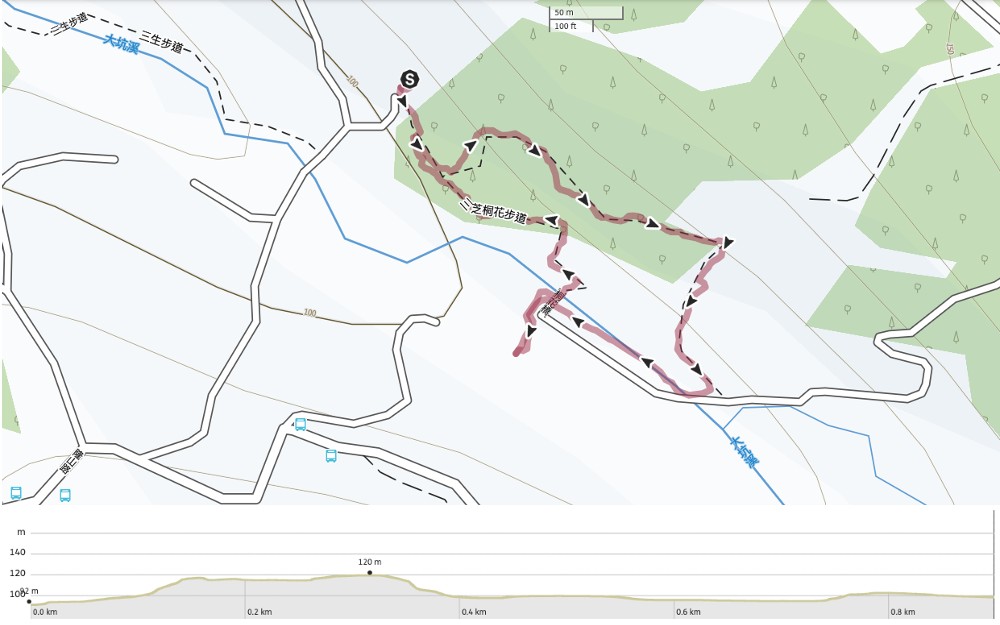
GPX file available here on Outdoor Active. (Account needed, but the free one works just fine.)
 Taiwan Trails and Tales