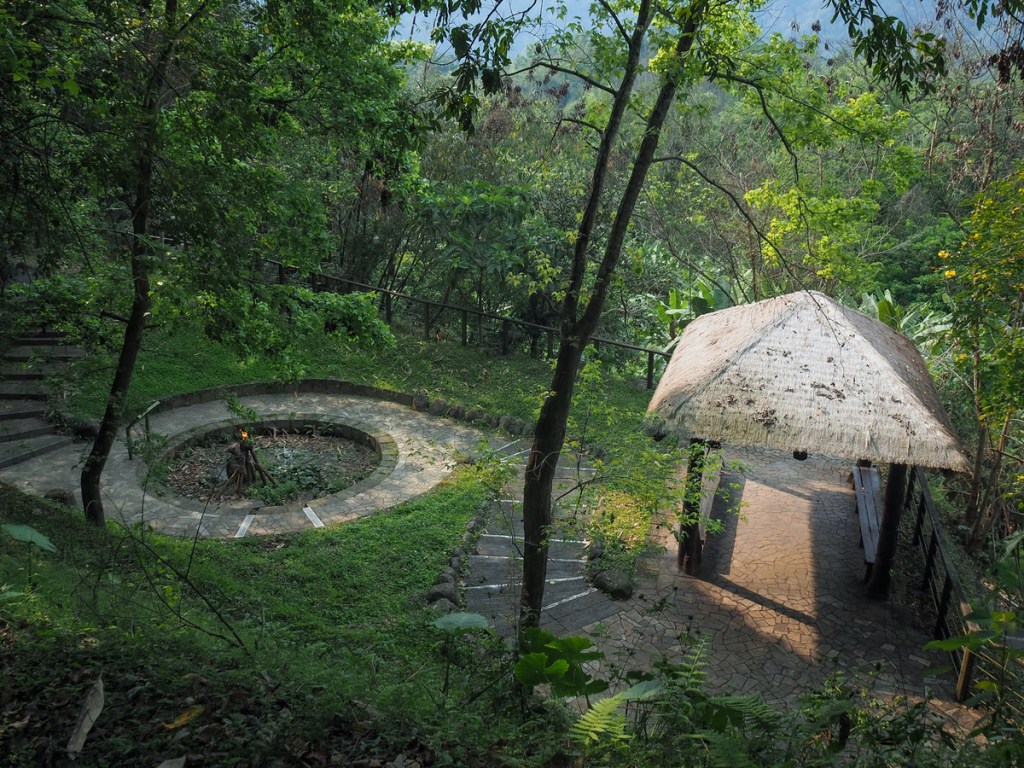
Chashan (or Cayamavana as it’s known in the Tsou language) is a uniquely diverse Indigenous village high up in the hills of Chiayi’s Alishan Township. The village’s population is comprised of a majority of Tsou, then Bunun and then Han, and is famed for its large collection of hufus (thatch-roofed pavilions where people gather, chat and share food). There isn’t all that much that goes on here, but the village does have a couple of homestays where you can stop a while and escape busy city life or learn a bit about the culture of the Tsou and Bunun communities. In addition to its cultural appeal, Chashan also boasts a unique natural phenomenon — the fire and water spring.
Distance: About 2.5 kilometres.
Time: 1 hour, give or take a few minutes.
Difficulty (regular Taiwan hiker): 2/10 – This should be nice and easy for anyone used to hiking in Taiwan.
Difficulty (new Taiwan hiker): 3/10 – Even if you’re new to Taiwan’s trails, this shouldn’t be to challenging. There are some steps to climb, and junctions to navigate, but the entire walk is short and well-signposted.
Total ascent: Around 100 metres.
Water: I took a small 0.5L bottle with me but didn’t drink much.
Shade: The walk back along the road is exposed, but the rest is shady.
Mobile network: A little weak in some parts.
Enjoyment: The walk itself isn’t a particularly memorable one, but a perpetual fire spring is a pretty cool thing to see. It’s definitely worth stopping by if you’re in the area, but I wouldn’t make a special detour to come here.
Bathroom facilities: There’s a toilet block beside the road close to the start of this trail.
Route type: Loop
Permit: None needed
Jump to the bottom of this post for a trail map and GPX file.

The walk starts beside a statue of a Tsou hunter and his dog.


A trailhead on the right takes you up steps and along the first part of the walk. On the maps, this section is referred to as the Tun’abana Trail (屯阿巴娜步道).

The steps lead up to a trailside pavilion, although, since it’s in Chashan, perhaps it would be more accurate to call this a hufu. The village is famous for its proliferation of thatched-roofed hufus, places for residents to gather, share and shoot the breeze.


Slender stems of bamboo line the path making for a pleasantly shady corridor.

Some type of tree nut that appears to have been nibbled on, likely by a flying squirrel.

After just a brief climb, the steps reach a high point and begin descending instead.

It didn’t take long for me to find myself reconnected with the road. Here, take a right turn and head away from the village for a couple of hundred more metres.

A maroon oriole. This was only the second of these fabulously bright birds that I’ve seen, but I wonder if perhaps their numbers are increasing, because within the space of three months, I would go on to see another two more.

There’s more bamboo tunnelery going on along the (evidently infrequently travelled road).


At the next junction, continue straight, then just after passing a tiny two-car parking area, take a left turn, both times following signage to the Fire and Water Spring.

A grove of humongous banana palms surrounds the short path leading to the spring.

I’m not sure what I was expecting from a perpetual source of fire and water, but I don’t think it was this. The gas is funnelled through a metal pipe fashioned to look like a torch supported by three hands, while the water (or rather, mud), bubbles up from the ground.
It was simultaneously more mundane and more amazing than I had imagined, although the mundanity mostly stemmed from the fact that it had been artificially channeled and therefore felt like it could have been entirely manufactured. Seeing fire bleeding directly from the earth would have been undeniably cooler. The time of day you visit also has some impact. A dusk visit would be more impressive.

A flight of steps leads away from the spring on the far side of the clearing to where I entered. At the top of the steps, I turned left onto an agricultural track that was signposted as heading back towards Chashan Village.

Along the way, you can spot Chashan Waterfall (or Chayama Waterfall) from the path. Tourism based on the landscape and indigenous culture form the backbone of Chashan’s economy, and the waterfall and the spring (as well as traditional crafts or activities) feature in village tours led by indigenous residents.

The track soon leads back to the carpark by the banana grove. You could follow the same road all the way back, or you could take the trail on the right and go a slightly different way back.


The wooden trail cuts through the trees for a short distance.

Then very soon, I found myself on a narrow lane running more or less parallel to the one I’d been on earlier. Turn left onto this and follow it all the way back to the start of the trail.


How to get to Chashan
Google Maps address: The walk starts and ends close to Chashan Presbyterian Church. You should be able to find places to pull up and park along the road nearby. Failing that, there’s a carpark of sorts right beside the fire and water spring.
GPS location: N23 17.830 E120 40.005
Public transport: There is a bus stop in Chashan, but the service is primarily designed to serve locals, so it’s not likely to be of much help for tourists or hikers. At 7:00 and 15:30 on Tuesdays and Fridays, the Xingfu Alishan Route 1 bus departs Longmei bound for Chashan, and at 8:10 and 16:50 (also on Tuesdays and Fridays), it returns from Chashan to Longmei. Services on other days of the week only run by prior arrangement — as in you need to call the bus company five days in advance of your journey to request the service.
Further reading: I wrote about a few attractions in and around this area for this article in Travel in Taiwan Magazine — there’s definitely enough nearby to warrant a short trip.
Chashan Fire and Water Spring Map
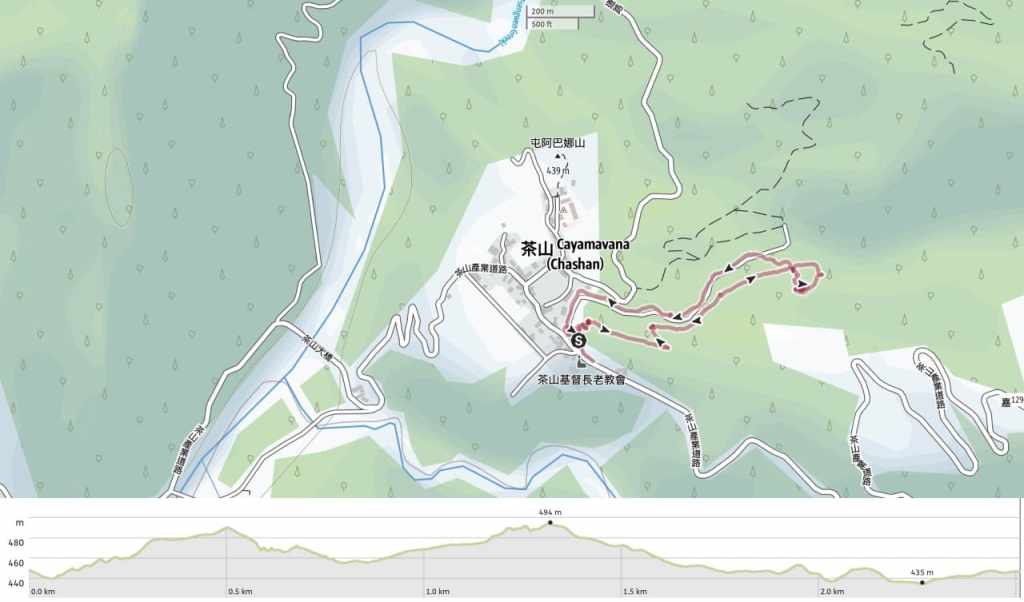
GPX file available here on Outdoor Active. (Account needed, but the free one works just fine.)
 Taiwan Trails and Tales
What a lovely trail!
🥰
LikeLiked by 1 person
It’s certainly quite a unique spot.
LikeLiked by 1 person