A Bat Cave, a Waterfall and a Unique Mountain Temple in Taoyuan’s Fuxing District
Sanmin Bat Cave was one of those places that had somehow managed to sit on my “to visit” list for almost seven years before I finally got around to visiting it. It’s a remote spot in the hills of Taoyuan’s Fuxing District, and while not really difficult to get to if you have transport, for some reason, we had just never gotten around to it. I am glad to have finally made it though. This walk was exceedingly enjoyable—the trail was far prettier than I had imagined, and there are points of interest at both the start and the midway point. If you have the time, this walk is one that is very much worth your effort.
Distance: About 4.8km.
Time: The walk took us two hours at a gentle pace. We also spent about half an hour looking around the temple.
Difficulty (regular Taiwan hiker): 2/10 – Some elevation gain and some slippery steps.
Difficulty (new Taiwan hiker): 3-4/10 – The trail involves climbing some steps, but that’s probably the biggest challenge presented.
Total ascent: About 250 metres.
Water: We took 0.5L refillable bottles and topped them up at the temple. There are no convenience stores or snack stops along the way, so bring some type of sustenance too.
Shade: Generally quite shady.
Mobile network: I had almost no reception for the duration of the walk with Taiwan Mobile, but Teresa fared better with Chunghwa Telecom.
Enjoyment: I loved this walk. There’s a waterfall, clear streams, a very cool temple, and even the trail itself is pretty.
Route type: There-and-back.
Permit: None needed.
Jump to the bottom of this post for a trail map and GPX file.


The bus stop and carpark at the bottom of this trail is accessed via a windy village road in the hills of Taoyuan’s mountainous Fuxing District. Normally, when we’ve visited this part of Taiwan, it’s involved embarking on a several-hours-long steep climb in remote forests, so it was interesting to see a different side of the region.

From the carpark, a brick-topped track climbs to some toilets.

Beyond that, the incline becomes a little steeper, and we had to tread carefully to avoid slipping on the slick surface of the bricks. I guess the perpetually damp air and lack of direct sunlight make the conditions ideal for algae to grow.

The trail splits in two at a twisty observation tower. Right will take you up to Guanyin Cave Temple, and left goes towards Sanmin Bat Cave and waterfall.

We first headed left to see the cave. Steps pick their way down to a bridge across the crystal-clear waters of Sanmin Stream where silver flashes beneath the water’s surface revealed the presence of numerous fish.

As we got close to the cave, the steps ran close to a huge wall.

Visitors to Sanmin Bat Cave—despite the name—are unlikely to see many bats. In the past, the crepuscular cave was home to a large number of the flying mammals, but over the years, human activity has driven them away. A news report from 2020 suggests that changes to management of the area had precipitated a return of a small colony of (possibly) Lalashan fruit bats, but we didn’t catch sight of any. The cave also goes by the name of Shuilian Cave (水簾洞), or Water Curtain Cave, and it did at least live up to this name—thin trickles of water fell perpetually from the protruding upper rocky lip, lacing the air with a cooling mist.

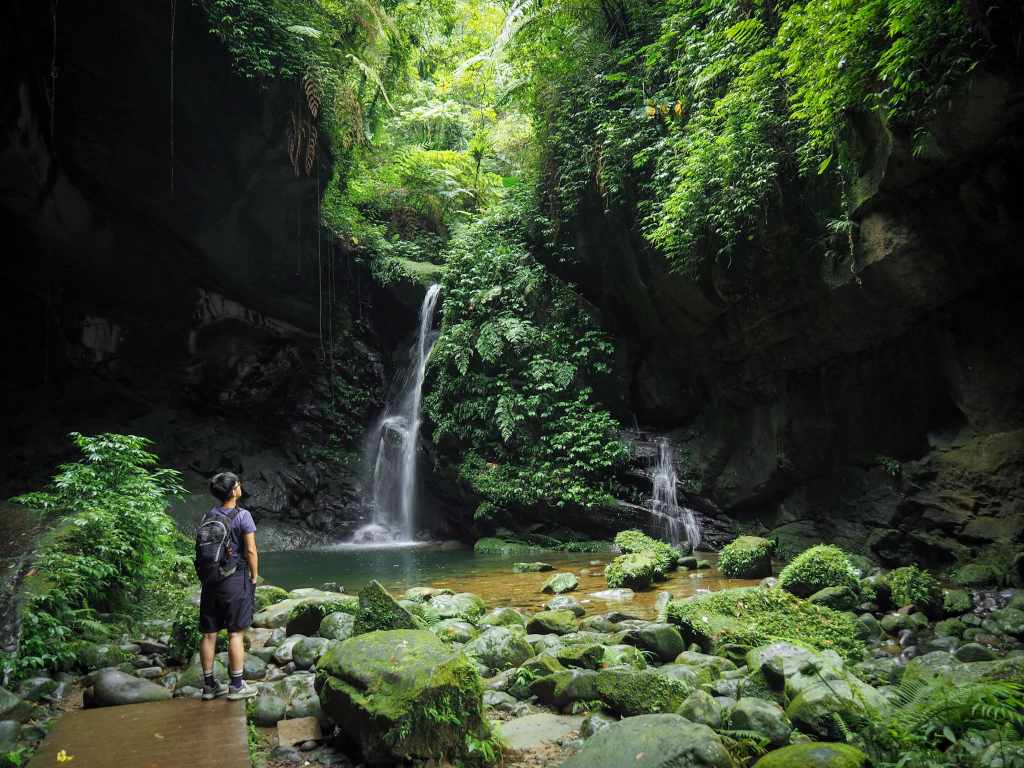
At the furthest extent of the walkway, there’s a waterfall cascading into a clear pool. Judging by photos I’ve seen elsewhere, the water volume was pretty low on the day of our visit.


After lingering in the cool valley for a while, we retraced our steps as far as the twisty tower thing and then turned left to continue our uphill journey.

A frog doing exactly what I wanted to be doing: lounging in a cool pool.


Although the trail climbs quite a way up from the water, it follows the track of the stream cutting through the valley. Rocks rise to the right side of the path and a railing on the left separates you from a steep drop.

Where a tributary runs down to join the main course of Sanmin Stream, a delicate-looking bridge has been spun high above the channel. Alarmingly, the metal panels buckle and bounce in ways that seem not entirely right for a bridge.

Although the entirety of the walk from Sanmin Bat Cave up to Guanyin Cave Temple is uphill, there are two especially steep sections. The first of those comes just after crossing the bridge.

There are lots of these quite ugly and intrusive drainage channels built into the path at irregular intervals. On the uphill side of the trail, one large bucket has been stuck into the ground with two more poking out of it and into the ground at right angles. The higher of these two allows water to spill into the large circular bucket, while the lower one carries beneath the trail and into a second large circular bucket on the downhill side of the path. Another opening on the downhill side of the second bucket disgorges the water down towards the river below. It’s not the prettiest solution, but when it rains in Fuxing District, it really rains, so perhaps it’s necessary.

At a junction, the path to the temple climbs up some wooden steps, and a small agricultural track on the left fords the small stream. At the point where the track dips to cross the water, an older woman in a bikini was sitting in the water while her other half snapped away on his phone.


One of the elements that made this trail especially enjoyable was the abundance of fern species growing all over the place. These two, (a skirted tree fern on the left and some type of tape or ribbon fern on the right), were extra special. The ribbon ferns look like nature’s most decadent home furnishings draped over tree limbs and hanging from rocky crevices.


Less showy, but equally pretty were all of the ferns decorating the forest floor. I like the sneaky little one on the left that’s pushed its way through a larger leaf.

The combined presence of all those ferns makes for a wonderfully lush and green landscape.


As the trail nears its upper terminus, the path draws closer to the stream again, and at a rest area, you can observe as the water cascades in a sheet over the rockface and into a deep plunge pool.

The second steep climb of the walk comes just before you reach Qiushan Qingquanyan Guanyin Cave Temple (秋山清泉岩觀音洞), which makes the sight of the giant golden Guanyin even more welcoming. The temple is exactly the kind which piques my interest. It’s remote, it has a backstory, it has oodles of character, and a welcoming atmosphere.
The temple’s master-manager is a tiny woman in her eighties who has the ability to talk up a storm and hold the crowd. We actually spent quite a long time at this temple because we slept in our car in the carpark the day before doing the walk, so we ate breakfast at one of the temple’s tables and watched Ms. Qiu go about her business, greeting visitors, leading people through the stages of worship, and receiving donations.
Qiu has devoted the past half-century of her life to managing the temple as a way to repay her debt to the gods here. When she was in her thirties, her mother suddenly developed symptoms of a mental illness, lashing out both verbally and physically. Considering the fact that Taiwan still has quite a long way to go with regards to providing effective and readily available mental health treatment, it’s unsurprising that—in the 1970s—Qiu struggled to find any doctors who were able to treat her mum. In desperation, she decided to turn to spiritual assistance.
Locals in this part of Taiwan had long known about a cave in the mountains above Sanmin Village. Sweet water filled from a spring beside the cave, and on the rock wall, mineral deposits resembling Guanyin—the Goddess of Mercy—had spontaneously formed. The water was known for its restorative powers in believers who either drank it, cooked with it or bathed in it. So Qiu took it upon herself to make trips to the temple where she prayed and filled up bottles of water that she took how to cook rice and boil tea for her mother. Miraculously, this unconventional treatment seemed to do the trick. Qiu’s mother’s condition improved, and Qiu dedicated the rest of her life to ensuring that the cave-dwelling deities are suitably worshipped. She raised funds to build the temple and has also installed several taps at one end of the carpark so that believers can easily collect water. It seems some people take this very seriously because we saw car after car pulling up with their boots full of 20-litre bottles. Judging by just how efficiently some families did their filling, I have to imagine it’s probably a weekly task for them.
It is hard to bite back my scepticism when I hear claims such as this, but it is not my place to judge. So long as no one is being prevented from accessing the help they need, it’s not hurting anyone. And scepticism aside, this temple has a wonderfully welcoming and peaceful atmosphere that made me want to linger.

As we enjoyed the incense-thick cool of the temple, we overheard Ms. Qiu telling one worshipper that she felt her work was almost done. She said she has one more altar that needs to be constructed, and then she’s ready to go.


Candles and bundles of religious artifacts placed on altars in the main part of the temple (left) and against the back wall where the Guanyin formations can be seen (if you squint).

A delightfully neon-lit Guanyin statue is the most noticeable feature within the temple. She stands atop a dragon whose mouth spurts out an almost constant jet of spring water.

Pre-botted spring water for devotees to take home in exchange for a donation and a prayer.


In an upstairs room in a side temple, a winged Hu Ye sits below an altar guarded by a dog.

More doggy goodness can be found in the garden. This one is a sceptical hound.
Once you’ve drunk your fill of holy water and paid your proper respects, you can head back down the same way you came. (There is a longer loop walk which can be done from here, but in the summer heat, there was no way we would be doing any more.)
How to get to Sanmin Bat Cave
Google Maps address: The walk starts at Sanmin Bat Cave car park and climbs to Qiushan Qingquanyan Guanyin Cave Temple (then heads back down the same way). There is parking at both ends, but if you decide to start and end at the temple, then make sure you park in the upper-level car park so that people wishing to fill up their cars with holy water have easy access to the spring.
GPS location:
- Sanmin Bat Cave trailhead – N24 50.305 E121 20.955
- Guanyin Temple trailhead – N24 49.815 E121 22.060
Public transport: Getting here on public transport might be a bit of a faff. You will need to first catch a bus to Taoyuan Bus Company’s Daxi Terminal Station. From there, you’ll have to transfer to the 5107 (or the 5107A/B/C) service that runs between Daxi and Sanmin Bat Cave bus stop. There are just a few services each day so you’ll need to check carefully to make sure you don’t get stuck up there.
Further reading: Josh Ellis has some nice photos of the bat cave on his site, and there’s an old Richard Saunders article about the walk in the Taipei Times archive.
My new words learnt on this hike:
- 脫水 / tuōshuǐ / dehydration or dehydrated (“小朋友很容易脫水” – “Kids can easily become dehydrated.”)
- 萬安演習 / wàn ān yǎnxí / Wan’an Drill – The annual military air raid exercises were scheduled to take place the day after we walked this.
Sanmin Bat Cave Trail Map
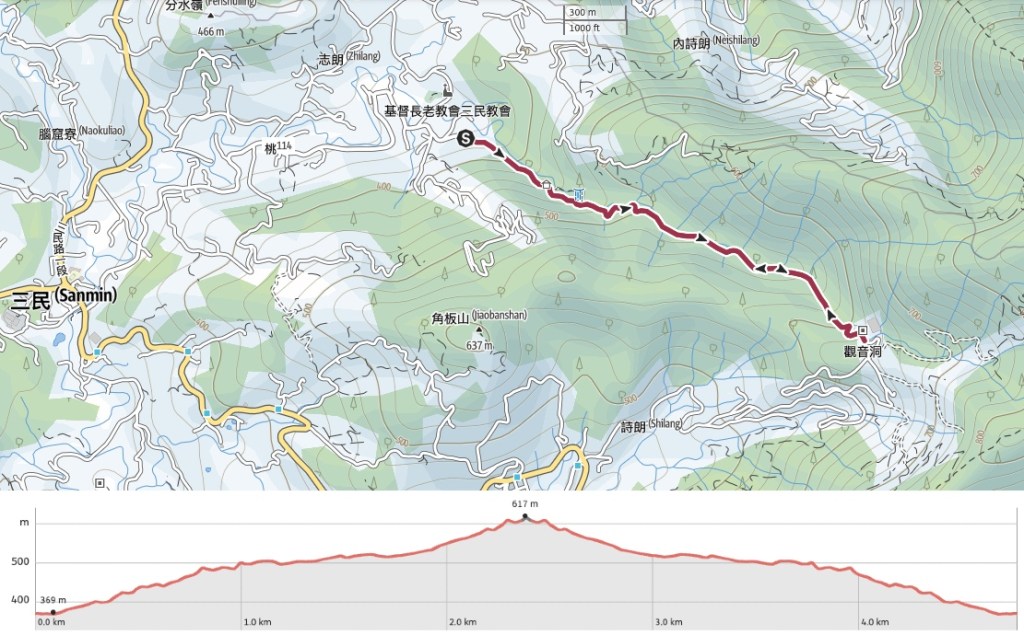
GPX file available here on Outdoor Active. (Account needed, but the free one works just fine.)
 Taiwan Trails and Tales