
The majority of Dengmiao Trail is in Changhua County, but for a brief moment it will take you over the border into Nantou County. It’s a casual, Sunday afternoon type wander with a good chance of spotting some Formosan rock macaques.
Distance: About 6km.
Time: 2-3 hours depending on how fast you go. I think it took us about Two hours and 25 minutes.
Difficulty (regular Taiwan hiker): 2/10 – Tiring steps in the heat, potential monkey encounters, otherwise nothing difficult.
Difficulty (new Taiwan hiker): 3-4/10 – The steps are probably the most likely to cause new hikers trouble, thankfully they’re quite short. Additionally, there are monkeys in the area, and the signage isn’t all that good.
Total ascent: A little over 300m.
Water: A single refillable bottle should suffice, the temple at the top of the hill has free tea and a water dispenser.
Shade: Large stretches are not very shady, I should have taken my umbrella.
Mobile network: Pretty clear throughout.
Enjoyment: There’s a pretty high chance of spotting monkeys if that’s your thing. And the temple at the top has some good views.
Other: Signs in the area warn walkers to be careful around the monkeys. Don’t eat in front of them, or take anything out of your bag that they could think is food. And don’t stare directly at them. We saw a handful and none of them were interested in coming near us.
Route type: Loop
Permit: None needed
Jump to the bottom of this post for a trail map and GPX file.

This trail starts from a large-ish parking lot at the bottom of the hill. As soon as we opened the doors of our car we were greeted with a cacophony of barking, so much in fact that I was almost certain that there must be a dog sanctuary nearby (there isn’t, there are just a lot of dogs). Take the steps leading up by the toilet block and follow them up to the left side of Fengbo Plaza.


The trail proper starts just beyond the open plaza. Prominent signs warn hikers that the area is known for having a large monkey population and that they aren’t afraid of humans. Visitors are told to follow the three principles of no contact, no disturbance and no feeding. We saw quite a bit of monkey poo around, but no monkeys themselves.

The majority of this trail sees you following wide, gently sloping tracks up the hillside under the shade of leafy trees. In a couple of places it gets a bit steep, but never too bad.

The gentle part ends at a shelter with another map, and from here there is a steep flight of steps leading up to the road that runs along the spine of this hill. A sign placed at the bottom of the stairs says that it’s called “摸乳巷” which could either be translated as the sound-for-sound “Moru Alley,” or the more colourful “Touch Breast Alley.” I’m pretty sure this name stems from the fact that the steps follow a narrow channel between steep rock surfaces so that hikers have to squeeze past one another when travelling in opposite directions (this is based on the fact that there are other lanes around Taiwan which share the same name.)

The steps climb up through a narrow channel, the sides of which have been reinforced with concrete. Looking at nearby slopes that haven’t been treated this way, it looks like the earth here is similar to that found on Fire Mountain, or a little further south, all loose pebbles packed down tightly in sandstone that’s more like sand. The kind that is very easily collapsed by heavy rain.

We ignored the side trail on the left here and continued heading onwards and upwards. At the top of the steps we turned right towards the temple. (Although we would later return and take the steps leading down on the far side of the road.)

The little hilltop community around Songboling Shoutian Temple (松柏嶺受天宮) is very ready to welcome tourists and hikers.

The grand Taoist temple is dedicated to Xuanwu (or Xuandi), and is a pretty old temple by Taiwan standards. The current building is relatively new, but devotees first established it 1657 (although at that time, the location was a little further downhill). There are various colourful folktales involving the history of this place, with one claiming that even after the original temple site had been abandoned, villagers could see a glowing light emanating from its location in the darkness, and another saying that Xuandi himself appeared in the form of an old man and went to the woodcarvers of Lugang to commission some smart new statues for his altar. (No word on who had to pay for them.)

Teresa decided to pay her respects while she was here, and we made our way around each step of the devotional route, pausing to pray and then figure out where to go next. One interesting thing I saw here that I haven’t seen too often before is that people were queuing to ‘bathe’ in the smoke from the censer right in front of the main altar. When it was their turn, they would step up, scooping handfuls of the incense laden air towards themselves and work their way down from their head to their legs, brushing it over their hair, then another scoop, face, another scoop, neck, arms, chest, stomach, legs, each new motion requiring a new handful of smoke filled air.


After we’d finished, we strolled across the courtyard to loop at the view far below. To the left, it was possible to make out the distant peaks of Yunlin’s Dajian Shan – one of my favourite walks from 2021.


We took a little longer to fill up our water bottles with the temple’s free tea, then headed back in the same direction that we’d come from. Rather than walking back down Touch Breast Alley, we decided to turn the walk into a loop and head down the steps on the far side of the road (behind the chickens).

Shaded wooden steps took us downhill, and soon we were rewarded with our first monkey sighting. One larger monkey came sauntering up the path in our direction, only to retreat to a safe distance as we drew close. Another, less coordinated one came crashing through the trees on our left, barrelling straight up a tree when it realised there were people in its way.

The steps soon ended and became a sloping farming track. Or perhaps it wasn’t really a farming track, I’m not so good at reading the land in this region as I am up north.

There are certainly portions of it that are very maintained, but some of it seems to be more educational rather than agricultural.

The track eventually becomes a proper road, and we found ourselves walking down through rural hamlets. It was just as we drew level with the water tower in the above photo that I experienced one of the most terrifying things that has happened to me in all my time hiking in Taiwan. There was a thwacking sound followed by what sounded like some kind of engine starting up, and suddenly the bush to our left EXPLODED with hundreds of huge buzzing things. I made a sharp retreat uphill and out of the path of the swarm, only for a second swarm to explode outwards right next to where I had just gone. I never got a clear look at them, so I can’t say for sure what they were, but they were large, the size of bumble bees, and thankfully they were not interested in pursuing us (we would have been royally buggered if they were). Once I had got my heartbeat back down to an acceptable level, we noticed monkeys nearby and came to the conclusion that one of them must have been bothering a hive.


Looking around there were quite a few of them feasting on the local homeowners’ trees (despite the monkey-proofing that had been set up to deter them). And the moral of the story:
Never.
Trust.
Monkeys.

An old rubbish truck that has, itself, become rubbish.


We followed the road down all the way to the end (there used to be a shortcut through trees on the left, but after a quick check, we established it was too overgrown and full of mosquitos to attempt with just short sleeves). At the junction we turned left onto Shanjiao Road, following it through a village until we joined up with a strram.

At the stream, we turned left again and headed slightly uphill until the road deposited us back at the trailhead where we had started the walk.
How to get to Dengmiao Trail
Google Maps address: We parked at Fengbo Plaza, climbed to Songboling Shoutian Temple, then looped back. There is also parking at the top of you’d rather start and finish at the temple.
GPS location: N23 49.360 E120 37.150
Public transport: It’s about a 20 minute walk through the town from Ershui railway station to the start of the trail. Ershui is served by all local trains, and but some express trains too.
Nearby trails:
Dengmiao Trail Map
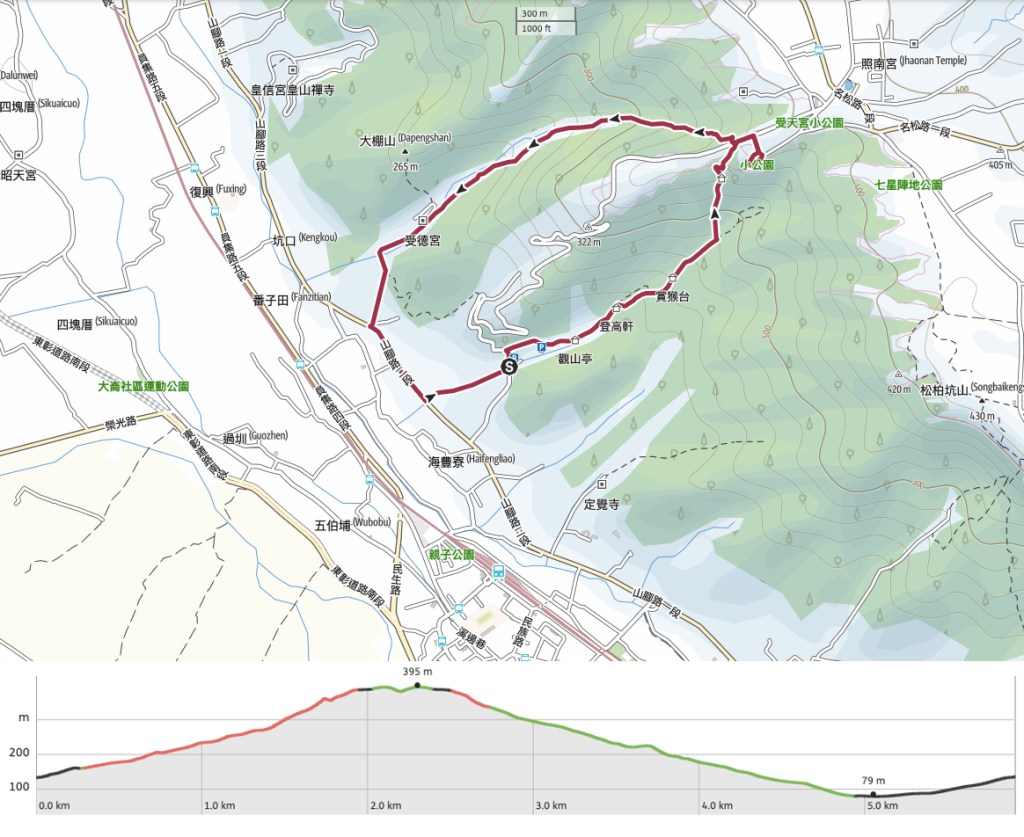
GPX file available here on Outdoor Active. (Account needed, but the free one works just fine.)
C
 Taiwan Trails and Tales