Keelung is one of those places we end up gravitating towards when we want to go out, but don’t have much of a plan. There are plenty of short walks in its hill to keep you entertained on an otherwise dull weekend, and that’s exactly how we ended up coming to Crouching Tiger Hill. This brief loop walk isn’t going to feature in any guidebooks, but if you’re looking for something to do, then why not. It has an interesting temple at the start and feels a bit like a mini adventure exploring one of Keelung’s unknown peaks.
Distance: 1.3km – a very short loop.
Time: 1¼ – at least 20 minutes was spent in the temple.
Difficulty (regular Taiwan hiker): 2/10 – It’s a little rough around the edges, but it’s so short.
Difficulty (new Taiwan hiker): 4/10 – It might feel a little too rough if you’re unfamiliar with the terrain and plant life of Taiwan, but it’s fine for a short adventure out of your comfort zone.
Total ascent: Less than 100m.
Water: A single refillable bottle will suffice, the temple has water dispensers, both inside and near their toilets.
Shade: Pretty thoroughly tree-covered except for the short road section.
Mobile network: Ok throughout.
Enjoyment: I liked this, it’s rough, but short enough to be manageable, and the temple has great English information accessible online using QR codes. Teresa wasn’t such a fan. Just make sure you’re prepared for overgrown conditions when you go.
Other: Even in winter there were a lot of mosquitoes, so bug spray and full sleeves/long trousers would be a good idea.
Permit: None needed.

The walk starts at the entrance to Daitian Temple. It’s possible to bypass the temple entirely, but more enjoyable to wander through it first.

The ground floor main hall is dedicated to Lü Dongbin, one of the eight immortals and the tutelary deity for miners (a role similar to the patron saints of various professions in Christianity). The Daganlin area of Keelung city where you can find the temple previously supported a successful mining industry, and it’s likely that miners would have sought out Lü Dongbin for advice on where to focus their efforts.


To the right of the main altar, you will find the Phoenix Hall (鸞堂), where a wall is given over to photos, certificates and artefacts related to the practise of Flying Phoenix spirit-writing. This is a tradition associated with Daitian Temples in which certified spirit-writing practitioners use a flying-Phoenix planchette to channel the words of the divine entities into characters traced sand or incense ash. Evidently, you need to visit on Saturday afternoons if you have a question for the gods, as that’s when the temple holds weekly spirit-writing sessions.
We walked across the front of the main altar, passed a side altar dedicated to Fude Zheng Sheng, the God of the Land, and out towards the service area where there is an altar for Dicang Wang which is shared by many black and white photos depicting noteworthy deceased members of the temple community.

The steps at the rear of the temple lead up to a second-floor hall where Teresa stopped to enquire with the gods about a work issue. Here you can find the Five Lords of Grace and the Jade Emperor.

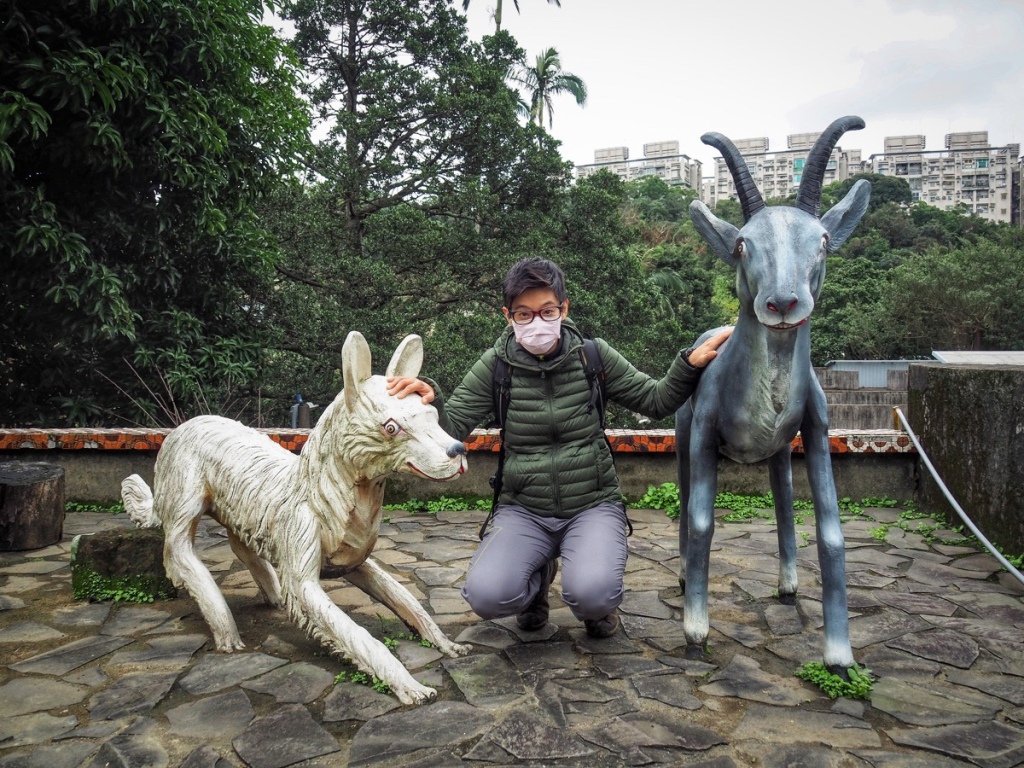
Continue up one floor further and you’ll find yourself on a rooftop courtyard and you can pick up the trail from the rear of the building. A little further away there is a collection of extremely manic-looking animal sculptures. I forced Teresa to pose with them for my amusement.

Steps lead up through a cultivated orchard of cherry (or maybe plum) trees.

There is a view, but it’s not a particularly inspiring one.

The steps climb as far as a pavilion with some type of communications equipment. The bench in the pavilion has crumbled away – it seems the popularity of this place has waned over the years.

There are two more trails leaving away from here. We took the flatter of the two which heads towards another archway.

There is dense foliage pushing in from all sides, and the old concrete path is broken and slippery.

There aren’t many junctions on this short trail, even trails which look like they existed on the map at some point are no longer visible through the trees. Take a left here to visit the peak, then later come back to take the flatter trail leading straight on.

Crouching Tiger Hill, although bestowed with a cool name, is not all that impressive. It’s marked by a summit sign and several fading hiking tags.

There is a view…of Xiehe Power Plant and some of the hills along the coastline.

We headed back the same way we’d come, the aged concrete steps even more slippery on the descent.

Once back at the junction, we took the left trail heading in the direction of Neimu Hill (內木山).

It’s clear that this path doesn’t get many visitors, there are lots of fallen trees across the trail and plants encroach from all sides. But it’s relatively flat and easy to walk.

The trail draws close to some buildings and on the left there are signs of some abandoned houses. Look out for the hiking tags on the left which will direct you upwards.

Just a couple of minutes later we found ourselves atop Neimu Hill. At 115m above sea level, it’s a smidge lower than Crouching Tiger Hill’s 125m.

There are also signs of old defensive trenches around the perimeter of the summit. There are structures like this in the hills all around Keelung, many dating back to the Sino-French war of the 1880s. I’m not sure if this is the case here, but I wouldn’t be surprised.

From the peak, we decided to push through and follow the trail heading straight over and follow the ridge on the far side.
I have no idea when someone last visited here. We were almost entirely reliant on the tags tied to the branches at ten-metre intervals. It was slow going and full of more mosquitoes than I’ve ever seen anywhere in the winter, but despite that, I found it rather fun. (Teresa’s opinion was not quite the same, she wasn’t in the mood for this type of walking this day.)

Close to the end it became almost impossible to see the trail – we could see the roof of a building where the trail was meant to come out, but it was impossible to see how to actually get down there. In the end we just picked our own way down.

The path emerges right next to this little temple (on the right of the photo is where the trail comes out). From here we turned right onto the road and within two minutes found ourselves right back at Daitian Temple.
How to get to Crouching Tiger Hill
Google Maps address: The trail starts behind Daitian Temple in Keelung’s Zhongshan District. There is a carpark (which charges a fee) right outside the temple.
GPS location: N25 08.975 E121 43.105
Public transport: Take a train to Keelung Train Station then take the 303 from outside the station then get off at Daitian Temple stop.
Nearby trails:
- Bitoujiao
- Heping Island Park
- Keelung Islet
- Mount Gongziliao
- Mount Keelung
- Rongxuan Trail
- Wangyou Valley Trail
Crouching Tiger Hill Trail Map:
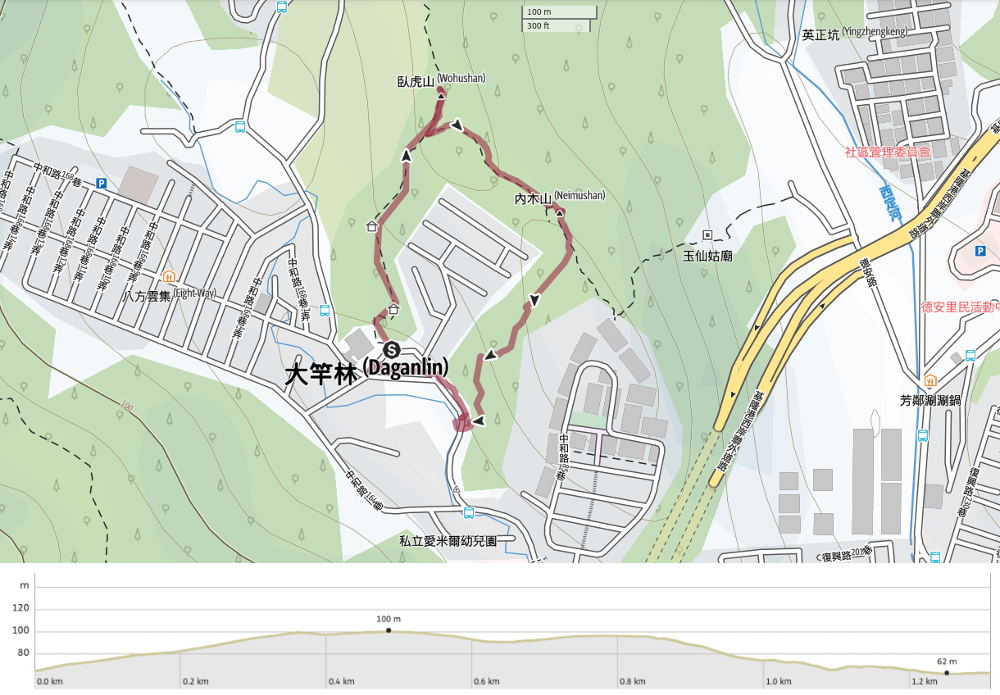
GPX file available here on Outdoor Active. (Account needed, but a free one works just fine.)
This is the bit where I come to you cap in hand. If you’ve got all the way down this page, then I can only assume that you’re actually interested in the stuff I write about. If this is the case and you feel inclined to chip in a few dollars for transport and time then I would appreciate it immensely. You can find me on either Ko-fi or Buy Me a Coffee.
 Taiwan Trails and Tales