MSTW SECTIONS 31
On the penultimate day of the MSTW, I was finally joined by Teresa as we made our way onwards and upwards to the summit of Jade Mountain. The morning’s weather was perfect and the trail stretched out in front of us with beautiful scenery all around. It felt like such a treat to be able to share this beauty with Teresa after a week of hiking solo.
MSTW PASSPORT STAMPS: The final stamp is located in Paiyun Mountaineering Centre.
DISTANCE: 8 kilometeres. (A couple more kilometres if you choose to walk from Paiyun Mountaineering Centre to Jade Mountain Trailhead.)
TIME: We spent about 7 hours walking. After walking by myself for several days, walking with Teresa felt a lot slower
TOTAL ASCENT: About 1,050 metres.
DIFFICULTY CONSIDERATIONS: While the distance and overall elevation gain aren’t extreme, the altitude makes it harder. And if you’re not good at sleeping in shared spaces like Dongpu Lodge, you’ll be doing it tired.
FOOD, DRINKS & PIT STOPS: There are water dispensers at Dongpu Lodge, Paiyun Mountaineering Centre and Paiyun Lodge. Foodwise, you can arrange to have dinner (and breakfast the following day) provided at Paiyun Lodge. You will need to have brought all other food with you from Dabang and Tefuye.
TRAIL SURFACES: A mixture of dirt and gravel trails plus a few wooden walkways.
SHADE: Much of this trail is quite exposed and because of the altitude, you’re likely to feel the effects of UV rays more acutely. Proper sun protection (long sleeves, gloves, hat, sunscreen) is very important.
MOBILE NETWORK: Pretty clear throughout.
SOLO HIKE-ABILITY: The trail between Jade Mountain Trailhead and Paiyun Lodge is very easy to follow and not too challenging, but the risk of landslides and altitude-related illness means that it is a good idea to have someone with you.
OTHER: You must have secured both a National Park Permit and a Mountain Entry Permit before embarking on this part of the walk. It is also a good idea to have altitude sickness medicine. Even though I’d ascended as gradually as was possible, (not) sleeping at that elevation left me with a headache.
Jump to the bottom of this post for a trail map, GPX file and all the other practicalities.
DETAILS & DIRECTIONS:
Even though we weren’t really in any rush to get going, we were awoken around 6:30 by other hikers getting up early to embark on single-day ascents of Jade Mountain. We waited a bit to let the morning rush clear from the lodge, then got up to have breakfast and start sorting out our bags for the last two days. As it happens, Teresa had managed to forget to bring her hiking back, which meant that all she had was her tiddly 20L work bag, so a bit of stuff shuffling was required to ensure we had all the vitals packed. (We later saw hikers with MUCH smaller and MUCH bigger bags, but 20L is a little big less than is practical for a winter ascent.)

8:16 – From Dongpu Lodge, we made our way to the entrance of Nanxi Forestry Road and wandered up towards Paiyun Mountaineering Centre.

8:24 – Outside the service centre, you’ll find the last water dispenser before arriving at Paiyun Lodge serveral hours later, so if you forgot to fill up your bottles earlier, make sure you do it here.


Inside is where you need to present your National Park Permit and Police Permit. It’s also where you’ll find the final MSTW stamp.
The check-in process is very smooth. We just handed over our IDs and papers and the guy did his thing. The team in front of us was made up of five Japanese women and their male guide. It was obviously fate, because we ended up doing everything together with this group. We shared the shuttle bus with some of them, set off at the same time, leap-frogged each other all the way up, summitted almost together and even ended up finishing at pretty much the same time. Other groups overtook us or were overtaken, but these guys were with us the whole way.

The final stamp shows a blocky, artistic rendition of Jade Mountain itself.

8:45 – After checking in, we lined up to wait for the shuttle bus, paid our $100 dollars each and piled in with three of the Japanese team as well as a couple from another group.

8:55 – Jade Mountain Trailhead was buzzing with activity when we arrived. There were at least three groups getting ready to begin, all of which need to take the obligatory photo with the trailhead sign before setting off. Naturally, I forced Teresa to have her photo taken too, but the angle of the sun made the resulting image rather dark.


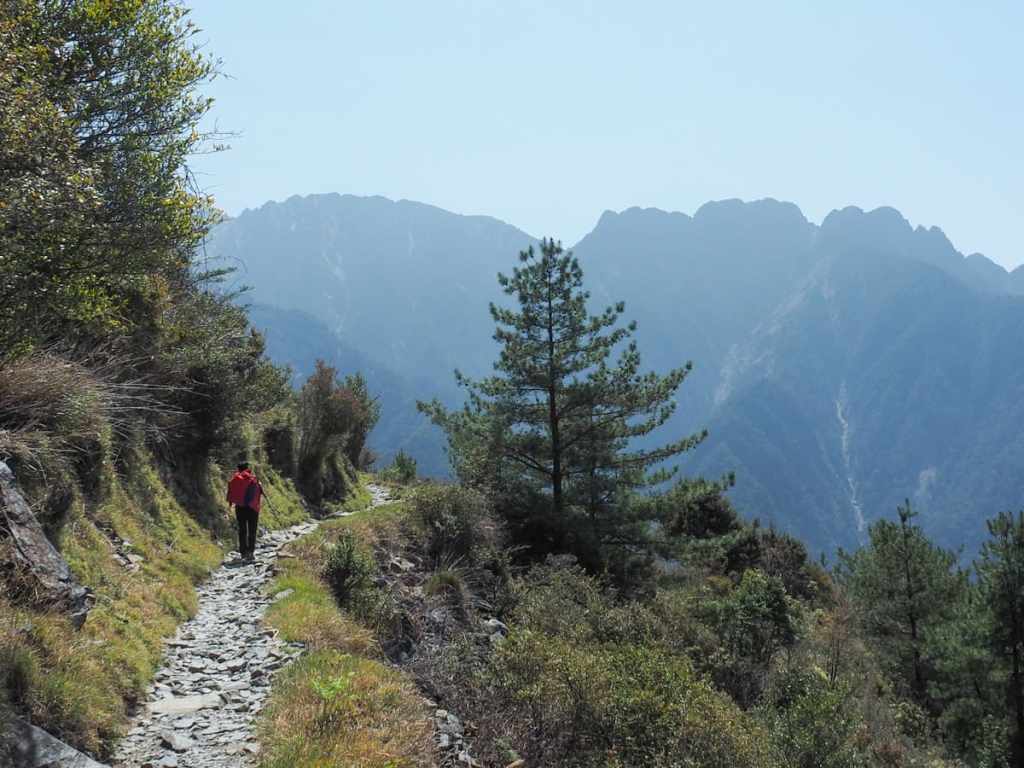
Setting off, I soon realised I was not going to be able to stop every single time I wanted to take a photo. Right from the get go, the scenery was just stunning. We had crisp blue skies and a strong sun that caused the slate scree to glisten with a pearlescent sheen.

It’s the kind of landscape that makes humans look all small and insignificant.

10:15 – Around 1.7 kilometres into the day’s walk, we passed Monroe Pavilion (named after an American tax consultant who perished during a 1952 ascent of Jade Mountain). Then, just beyond that, you’ll find the first of two compost toilets along the trail.


If you visit between February and June, you will likely see the deep pink buds or paler open heads of Yushan rhododendrons (玉山杜鵑, also known as Alishan rhododendrons or 阿里山杜鵑). These paper-petalled beauties range in colour from the crisp white of freshly laundered hotel sheets to a deep seductive red.


Pretty colours don’t just come in the shape of flowers either. On the left is something that might or might be sulphur dust lichen, and on the right is a shiny chunk of quartz.

The jaggedy ridge extends southwest towards Southern Jade Mountain (南玉山). Quite honestly, I am a little unsure as to how best to deal with the English translation of this peak’s name. Jade Mountain’s other peaks, including the west, east, main, and north, all have a different Chinese name, “玉山X峰,” which easily translates as “Jade Mountain X Peak.”

10:52 – After about two hours of walking, we passed the turn off that would take you to Jade Mountain’s Front Peak (玉山前鋒). If you want to walk this, or the west peak, or any of the other summits, you need to specify as much on your permit application. We hadn’t, and neither had we budgeted any extra time to visit them, so instead, we just continued onwards.


The quality of the trail building is top-notch. Thanks to all these smooth trails and steps, the climb to Paiyun Lodge is really very easy.

Moss and more lichen.


12:23 – Two and a half hours into the walk, we passed the second compost toilet and another pavilion with a built-in viewing platform. From up here, you can get a decent view of Jade Mountain—if it isn’t hiding in the clouds.

The toilet had a Perny’s long-nosed squirrel that had taken up residence and was squeaking quite noisily.

As we climbed higher, we increasingly found ourselves walking through forest dominated by Chinese fir and hemlock trees.

The understorey was decked out with arrow bamboo (often referred to as “Jade cane” on the English signage), and the taller firs soared high up above us.

13:52 – When we arrived at the Yushan Great Cliff, the group leader of the Japanese group had whipped off his shoes and socks and was giving a demonstration of how to use momentum and the tiniest chink in a rock to propel yourself easily up such a slope. It was fascinating—doubly so because of the chorus of excitable exclamations coming from his team members.

A white-whiskered laughingthrush with a beak full of Japanese andromeda.

In a gap between the firs and hemlocks, we came across yet more spectacular and different scenery.

15:12 – The very first glimpse of Paiyun Lodge through the trees. In clear weather, we should have been able to see Jade Mountain rising behind it.

15:22 – A few minutes after first seeing it, we made it to Paiyun Lodge. At 3,402 metres above sea level, I am confident. this is the highest place I have ever slept. There has been a mountain lodge here since the Japanese built the New High Mountain Rest Station (新高下休泊所) in 1934. After the ROC government took control of Taiwan, the facility was converted into a single-storey stone building (photos of which can be seen here and here).

We arrived, swapped our shoes for slippers, and checked in with a guy in a teddy bear hoody. We’d already paid for everything online, so it was just a case of showing him our ID and permits in order to be given meal vouchers and sleeping bags.


The rooms are… basic. There are 116 spaces, all of which are in long shared bunks. The bunk allocation system is a bit weird. Teresa and I were given beds 111 and 112. All odd bunks are on the bottom, while all even ones are on the top, which meant that we were separated. The staff said that we were free to ask others to swap with us, but as it transpired, we didn’t need to, there were only three people on the whole bottom row, and a similar number up top (I think they should have accommodated about 7 or eight people). I guess the cold weather out some people off.

Dinner was served at 5 o’clock. Both of us had the vegetarian option, and looking at the meat eaters, I felt that we had a far better option.
Almost as soon as we’d eaten, we brushed our teeth and retreated to bed to try and get some sleep. The lights went out a short while later, and our roommates began their night of cacophonous snoring.
GETTING THERE
You can get a shuttle bus from Paiyun Mountaineering Centre to Jade Mountain Trailhead. It costs $100 per person and to catch it, you just need to wait for one to turn up in front of the service centre.
GPS location:
- Start point – N23 28.540 E120 54.000
- End point – N23 27.980 E120 56.990
Accommodation:
Staying in Dongpu Lodge – There is just a single option for hikers wishing to stay in the area at the end of this day’s walking. Also, it is worth pointing out that camping is strictly prohibited within the national park except for in designated areas (none of which are nearby).
- Name in Chinese: 東埔山莊
- Name in English: Dongpu Lodge
- Address: 605南投縣信義鄉中山村自忠77號
- Contact: 0492702213
- Cost: $400 for a bunk in a dormitory. Each bunk can be separated from the one next to it by a curtain. Bedding is provided as standard, but that’s it.
- Booking methods: online form
- Clothes drying facilities: There is a line to hang up wet clothes, but don’t expect them to dry overnight up here.
Staying in Paiyun Lodge – Paiyun Lodge is the only place for hikers to stay at on-route to
- Name in Chinese: 排雲山莊
- Name in English: Paiyun Lodge
- Address: 605嘉義縣阿里山鄉中山村6鄰排雲101號
- Contact: 0492702228
- Cost: $480 for a bunk in a dormitory. Bunks have a thin foam mat and no dividers. Sleeping bags can be rented for an additional fee $300 per person.
- Booking methods: When you apply for and are granted a permit for the two-day Jade Mountain ascent, you will automatically be allocated a bed here.
- Clothes drying facilities: There is a drying room for hanging up wet clothes, but don’t expect them to dry overnight up here.
- Food: You can pre-book food (along with a sleeping bag) by downloading an order form and emailing it to the Paiyun kitchen team.
MOUNTAINS TO SEA GREENWAY DAY 10 TRAIL MAP
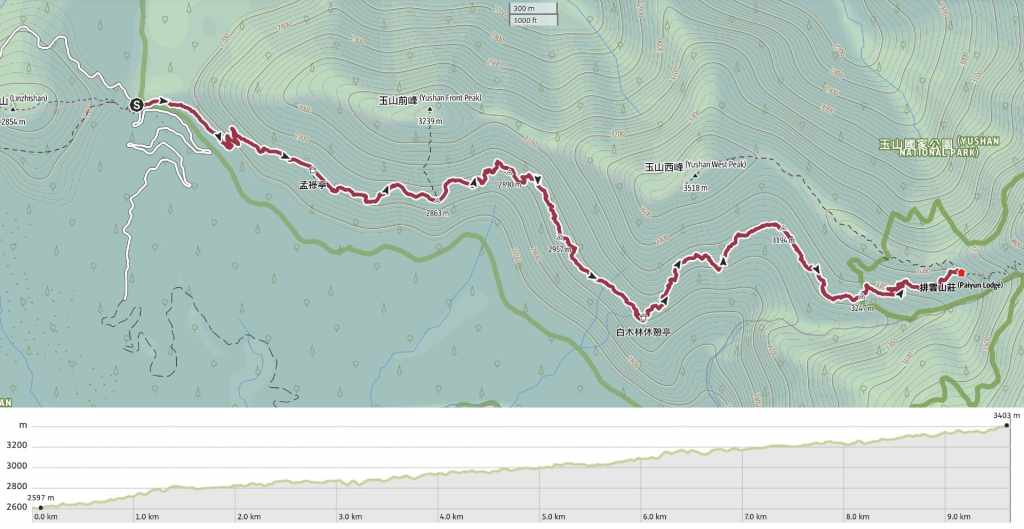
GPX file available here on Outdoor Active. (Account needed, but the free one works just fine.)
 Taiwan Trails and Tales
