MSTW SECTIONS 01-06
Taijiang Inner Sea to Shanhua
Day one on the MSTW is an easy bike ride inland over ground formerly covered by Taijiang Inner Sea. If you plan to take things slowly (as I most certainly did), you can spend a gentle day spotting all kinds of waterbirds, visiting temples, and enjoying the peculiar optics of watching rows and rows of rice flash by as you cycle past them.
MSTW PASSPORT STAMPS: 2 (kind of)
- The first stamp is located in the Taijiang National Park Headquarters (台江國家公園) – Closed on Mondays. Open 9am-5pm Tuesdays to Sundays. (Hours around national holidays are different.) I would advise collecting this the day before you begin your journey because despite being so very close to the start of the trail as the crow flies (less than 500 metres), it adds at least an extra 13 kilometres and would take about 40 minutes to cycle to the trailhead from here. If you are intent on doing it in a single day, start early and get a bus to the national park, then pick up a bike from the park’s YouBike stand.
- The second stamp is kept in Haiwei Chaohuang Temple (海尾朝皇宮) – Open daily 5:30am-9:30pm. This is a 3.6-kilometre-round detour from the route of the MSTW, but on a bike, that feels like nothing.
DISTANCE: 35km including the stamp collecting detour but not including cycling to or from the day’s starting and ending point.
TIME: A very casual 5 hours. Perhaps more like 6 hours if you include the time getting from and to accommodation at the end of each day. If I had been so inclined, I definitely could have combined the first two days into a longer single day.
TOTAL ASCENT: Around 100 metres very gradually over the course of the day.
DIFFICULTY CONSIDERATIONS: While the vast majority of the day’s cycling takes place on designated cycle paths, you do need to cycle with Tainan’s traffic to get to the start.
FOOD, DRINKS & PIT STOPS: I started the da with 1L of water and some snacks. There are a few pit stops beside the trail, and many more if you detour for 5-10 minutes. I topped up my water bottles at Haiwei Chaohuang Temple, Nanke Train Station to top up my water bottle and Shanhua Station (the dispenser is through the ticket barrier, so I had to ask the station staff if I could go through). All three are a bit of a detour from the main route.
TRAIL SURFACES: Well-surfaced main roads and bikeways.
SHADE: Little to no shade the whole way. For sun-shy folks, make sure to have a hat, long sleeves, and gloves.
MOBILE NETWORK: Clear throughout.
SOLO HIKE-ABILITY: No problem at all.
Jump to the bottom of this post for a trail map, GPX file and all the other practicalities. Or, for a video version of this post narrated in real time, you can watch this video.
DETAILS & DIRECTIONS:
Having arrived in Tainan the day before, my first morning on the MSTW began in a hostel where I shared complimentary bananas with a French traveller who was nuts kicking off a week-long stop-over in Taiwan. Bananas consumed and coffee drunk, I checked out and made my way to the nearest YouBike stand where I picked up my steed for the day and set off in search of the trail’s official starting point.

9:30 – The official starting point of the Mountains to Sea Greenway sits on a spit of land jutting out to sea at the confluence of Yanshui River and Yanshui River Drainage Channel. The spot is marked by a bike rest stop, some information boards and a sign designed to look like waves, forests and mountains springing forth from a book. I felt such delight to be here. I skipped collecting the first stamp because it’s held in Taijiang National Park Headquarters, which would have involved a significant detour.

After having spent so long planning this trip, it was very exciting. I even took a selfie to commemorate the moment!

Setting off, you can choose to either cycle along the levee or the road, the latter is so lightly trafficked that it’s a pretty comfortable ride. There’s a coastly whiff of the littoral, but it’s subtle enough to soon fade out of consciousness.

Thanks to the fact that it was under Dutch rule between 1624 and 1662, Tainan has more written historical records than many other regions of Taiwan. They wanted to find a good spot from which to trade, and that led to extensive surveys being carried out and maps being drawn up. From the maps of this era, we can see just how different the landscape used to be. Back then, a narrow spit of land separated the ocean from the more solid parts of Taiwan. Taijiang Inner Sea (台江內海), as this feature was known, stretched inland for quite some way. If you look at a modern map of the area, the inner sea reached as far south as Tainan City’s North District, as far east as Anding and Xigang Districts, and quite a way to the north too.

These days, the area is famed for its wetland habitats, mangroves, and abundant bird species. The endangered black-faced spoonbill is known to grace the region for about half the year as it overwinters here after flying south from its breeding grounds in China and Korea. I didn’t see any spoonbills, but I did see many different kinds of waders, some shrikes, azure-winged magpies, scaly-breasted munias, moorhens, ducks, grebes, prinias—a whole load of birds.

Over time, Taijiang Inner Sea became less sea and more land. One cause of this was the silt flushed downstream along the Zengwen River. According to one sign I came across along the way, the rate of land sprawl was remarkably rapid, with 35 metres worth of new land being measured one year. Another factor was human interference… or perhaps ingenuity. Many people used to make a living drying salt, raising milkfish, and culturing clams (I mean that in the sense that the clams are grown to be eaten, but I think I enjoy the double meaning). These pisciculture-related activities reshaped the land as farmers eked out patches of land to do their thing on, and the shrinking of Taijiang Inner Sea was accelerated. As I rode, I passed a lot of fish ponds, but it seems many have fallen into disuse.


Gradually, I cycled away from the peaceful soundscape of the estuary (gentle water sounds, the chatter and squark of birds, the conversation of fishermen, and the occasional pootling of a helmetless scooter rider), and into the noise of the city.

Crossing over Anming Road, I carried on heading inland along Jun’an Road, keeping the water to my left.

At the second bridge I came to, Haidong Bridge (海東橋), I turned left and deviated from the course of the MSTW to go in search of the trail’s second stamp.

The second stamp is kept in Haiwei Chaohuang Temple (海尾朝黃宮), which is about a kilometre or so off the route of the MSTW.

It’s kept just inside the temple, beside the window where you can purchase pre-packaged praying kits (spirit money, incense, and a snack).

The staff in the temple seemed perplexed to see me there and using it. So much so that one guy followed me around trying to get sneaky photos.

I arrived as the morning market in the square outside the temple was being shut down, but despite this (and despite the fact that it was a Monday, and not a weekend), the temple was quite busy. I asked one of the temple’s volunteers if it was a special day, and apparently I happened to drop in on Tudi Gong’s birthday (which also explained why I’d seen so many tables laden with offerings).


Enshrined on the temple’s main altar (behind plaques attesting the temple’s community work achievements), you’ll find the Baosheng Emperor or Baosheng Dadi (保生大皇), a former doctor from China’s Fujien, who (according to legend), rode around upon a tiger steed that he had cured from being hungry for human flesh.

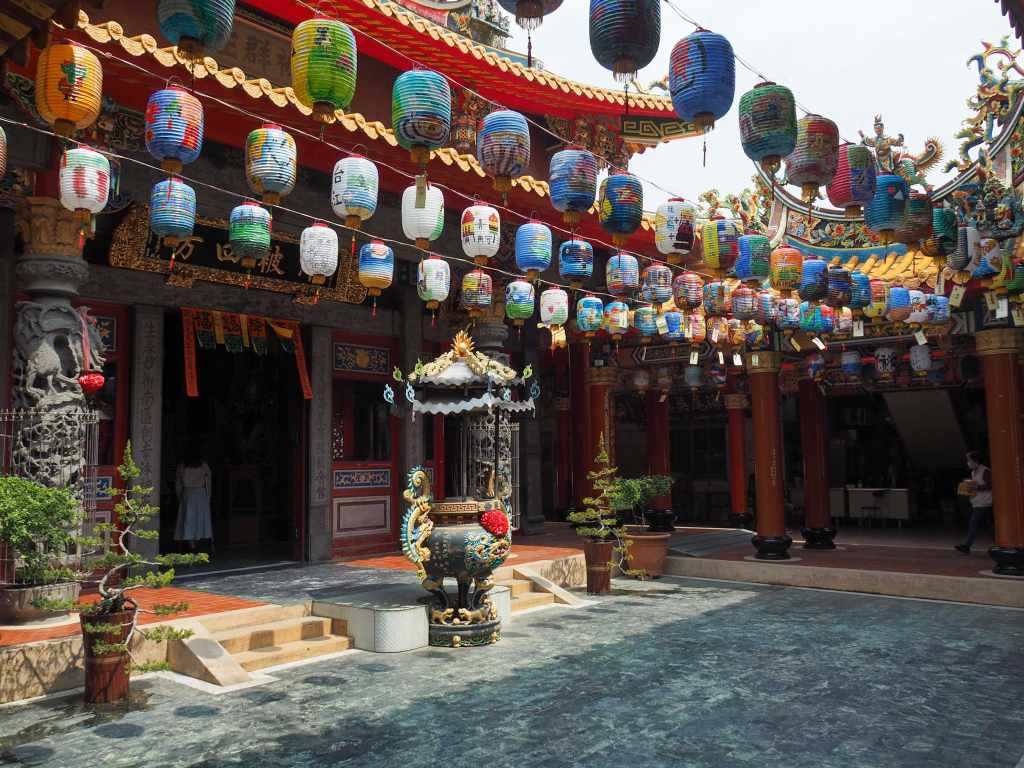
Taiwanese temples are not known for their understated colour-palette, but upon first impressions, this temple is even more colourful than usual. Strung about the forecourt are rows of paper lanterns decorated with children’s artwork. It’s a nice touch and speaks to the temple’s close community links.

In fact, Haiwei Chaohuang Temple has something of a reputation for being a mover and a shaker in the world of community templing. (Yes, I turned it into a verb.) It has been behind a small wave of temples in the surrounding Annan District that are embracing grassroots education and community-building. It makes sense. Before state schools were a thing, before public libraries and government-run facilities were in every municipality, temples were not just the spiritual hub of the community, but the everything hub. Education, health care, trade, everything happened in and around important temples. Serendipitously, the chairperson of Haiwei Chaohuang Temple, Wu Jinchi, and a journalist-turned-academic, Wu Maocheng, were both thinking about how to rekindle this spirit of a space for community and education, and it resulted in the establishment of Tainan Community College’s Taijiang branch. Fittingly, for a temple dedicated to a medicine man, the first course offered taught local residents about herbal healing, and it was a big success. Since then, the courses offered have been many and varied-as is evidenced both by their Facebook page, and by the boards of photos displayed proudly on the walls of the outer courtyard.

Stamp collectors will also be happy to hear that the temple has its own stamp.

After taking my time to take in the temple, I cycled back to Haidong Bridge to pick up the MSTW where I’d left off.

Then, at the next bridge, Annan Bridge (安南橋), I crossed back over the water to follow the cycle path with the water on my right. This next stretch took me through an industrial area with loads of huge factories to my left.

The air was hazy all day, which wasn’t great for cycling, but at least it made views like this look painterly.

One of the many tiny wayside shrines that were scattered around the place. Like Kinmen, Tainan has a proliferation of small shrines like these around junctions and bridges.

Where the waterway splits in two, signs direct MSTW riders to take the white bridge and follow the righthand fork.

Crossing over Changhe Road, I spotted the long, low facade of panels that hides the National Museum of Taiwan History. Carrying on along the waterway, a sign by the museum carpark indicates that this is a cyclist rest stop with bathrooms. If I were doing this walk at an extra slow pace, I would have spent the remainder of my day walking around here and enjoying the exhibits, but I still had a way to go yet.

There were a few more factories here, but for the most part, it was less built than the section I’d just ridden through.


After crossing a bridge, I found the MSTW had been rerouted around some construction work. The diversion was well signposted though, and before long, I was turning back off the road and onto a cycle path.

At least, I think it was meant to be a cycle path. I didn’t encounter any other cyclists, but I did meet quite a lot of scooter riders treating it like a shortcut.


At the end of the bikeway, take a right, then after about 50 metres, turn left onto Daoye Road. For the next 30-40 minutes, I was cycling through Tainan Science Park. If you keep an eye out for them, there are ample signs directing cyclists through the streets.


At the end of Daoye Road, take a right onto Nanke Third Road and follow that road until it intersects with Huanxi Road. Turn left onto Huanxi Road and cycle past banks of solar panels.

As you cycle through the area, look out for information boards pointing out the various archaeological finds that were uncovered when the park was being constructed. Just before you turn right onto Siraya Boulevard, one points out an old gravesite, elsewhere, it’s the remains of sugar distilleries.


Once you’re on Siraya Boulevard, stay with it until the road runs out. Cross under the high-speed rail, over the regular railway, then keep going. A little past Nanke Train Station, I took a coffee and cooling break in a convenience store.

Siraya Boulevard ends when it hits Provincial Highway 1. Cross over and follow the much smaller, narrower Miaopu Lane.


Signs direct you along the single-lane road past factories and fields, and more than once, I had to scoot to the side to let cars pass.

Then, when you find yourself crossing a waterway, take a left turn onto a cycle path.

This man-made channel is Chianan Big Canal, Nangan Branch (嘉南大圳南幹線). It carries water from Wushantou Reservoir (a stop on tomorrow’s walk), to farmland in the south. Its construction was planned and overseen by a young Japanese engineer named Yoichi Hatta, and it is part of the largest-scale hydro-engineering project ever to be completed in Taiwan.

Farmland to both sides of the waterway is planted with crops like rice and dragon fruit.

14:51 – When I hit Chenggong Road, I ended my day’s journey along the MSTW by turning left and heading into Shanhua (善化) to find dinner and my bed for the night.


Dinner turned out to be both easy to find and very satisfying (fried rice and soup plus some sides from a vegetarian 鹹酥雞 shop).

But the bed was another matter. It was one of the sketchiest-looking places I’ve ever stayed in, and I am 100% sure that the busy hostel I stayed at the day before was far, far cleaner. I wasn’t even given a key at first, just told that if I wanted to leave my room, I should lock it from the inside and then ask them to unlock it when I got back. Anyway, at least I had somewhere to rest my head.

GETTING THERE
To get to the start of the trail, you need to first make your way to Tainan. You can either take the HSR or the regular railway. I took the regular railway because the HSR station is about a 40-minute bus ride out of town. Once in Tainan there are YouBike stands everywhere, so you can use those to get from the station to your accommodation and from your accommodation to the start of the trail. If you’re just arriving in Taiwan, you will need an Easy Card (these can be purchased at literally every 7-Eleven or FamilyMart), and you will need to register your card at the YouBike before you can use the bikes. For a clear set of instructions on how to do this, you can refer to this information.
In Tainan, there are many YouBike stands to choose from, so when you’re ready to set off, just pick whichever is closest, but once you get to Shanhua, there are just a handful of places to return your bike. (Downloading the YouBike app is the easiest way to find where all of the pick-up and return points are.)
GPS location:
- Start point – N23 00.190 E120 08.560
- End point – N23 07.520 E120 19.525
Accommodation:
Staying in Tainan – Tainan is absolutely full of options for places to sleep from budget hostels to fancy hotels. I opted for a cheap hostel because I knew some of the rooms later would be more expensive. I was very happy with it. The beds were clean and comfortable and my roommates were considerate.
- Name in Chinese: 紡南
- Name in English: FunNan Guesthouse
- Address: 70053台南市中西區海南路二段259巷31號
- Contact: 066024919
- Cost: $650-$2,000+ (for a bunk or a private room, respectively)
- Booking methods: booking.com, Agoda, telephone
- Clothes drying facilities: No, but there are many laundrettes in the city
Staying in Shanhua – I wouldn’t exactly recommend this place, but there aren’t many options in Shanhua. The bed was very hard and the cleanliness of the facility was dubious to say the least.
- Name in Chinese: 富賓旅社
- Address: 741台南市善化區中山路339號
- Contact: 065837159
- Cost: $700 (I think this is the price for a 2-person room)
- Booking methods: telephone
- Clothes drying facilities: There’s a washing line, but no spin-dryer
MOUNTAINS TO SEA GREENWAY DAY 1 TRAIL MAP
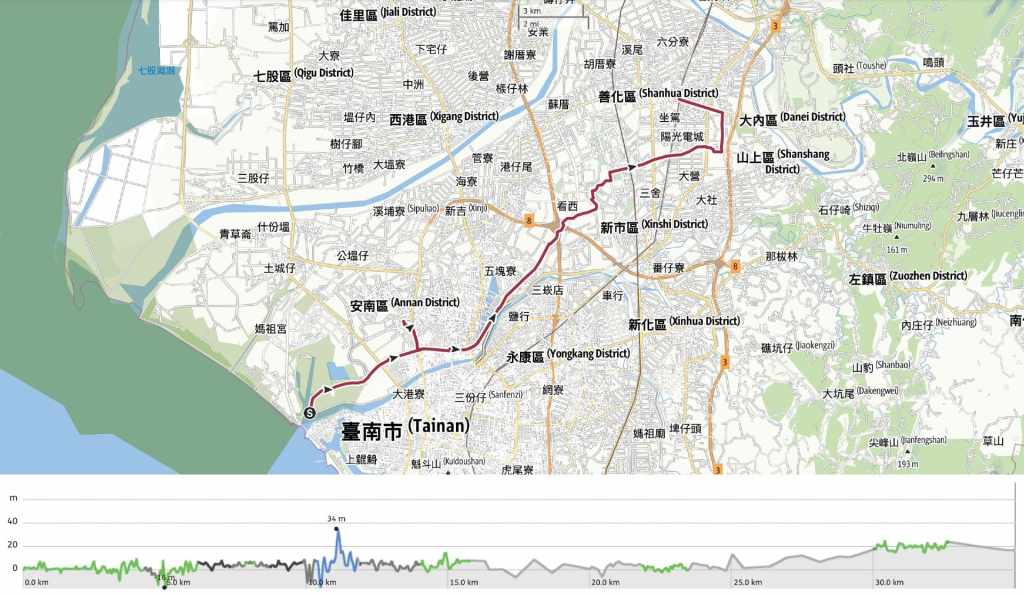
GPX file available here on Outdoor Active. (Account needed, but the free one works just fine.)
 Taiwan Trails and Tales