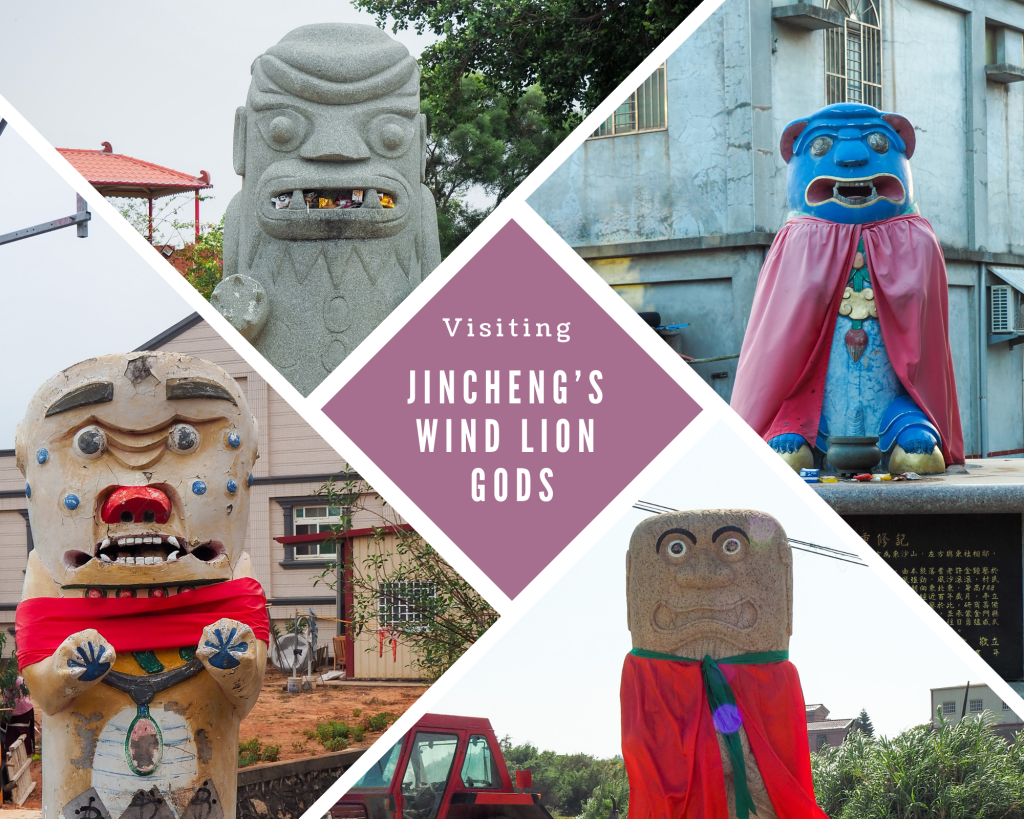
Located towards the western edge of Kinmen, Jincheng Township was where we based ourselves for the first half of our trip since this is where you can find the greatest assortment of hotels and restaurants. However, in terms of wind lion deities, this region is a little underrepresented. Of those featured in the app, only nine are in this region. That said, Jincheng is home to the Oucuo Village Wind Lion God, who is one of the most famous on the whole of Kinmen on account of its proximity to the half-buried tank on Oucuo Beach.

70. Xiashu Village – 夏墅
N24 25.540 E118 18.600
Xiashu Village Wind Lion God looks a little perplexed to find itself in the yard of a residential building. Apparently it wasn’t always here, but has had to relocate due to construction.

72. Kinmen Fort – 金門城
The Kinmen Fort Wind Lion Gods can be found at the rear of Huixiang Temple. At first glance, they look like an adult lion and cub, but the smaller one is in fact far, far older. The smaller one is the original wind lion god, and has been watching over the land for over six hundred years. For the past thirty years, it has been assisted in protecting the villagers by the larger statue.
74. Sihu Wind – 泗湖
Sihu Wind Lion God has to have one of the cutest expressions of all the wind lion gods. It looks almost so startled and fearful that you feel the villages should be engaged to protect it, rather than the other way around. The information given about this god on the app states that its power is strengthened by the fact that a white rooster is buried in the earth beneath its pedestal.

79. Guanli Village – 官裡
I’m a fan of the colour scheme of Guanli Village Wind Lion God. The faded blue of the statue and faded red of its cloak work wonderfully with the sections picked out in gold. The current deity was enshrined in 2007 after the original one was deemed to be in need of replacement.

82. Gugang Village – 古岡
The effect of hundreds of years of weathering and its off-kilter loom both make Gugang Wind Lion God look tall in photos. In truth, at 180cm tall, it’s quite an average height. It is, however, one of the older wind lion gods still performing its duties. This stone-carved beauty was first enshrined in 1785, making it well over 200 years old.

90. Oucuo Village – 歐厝
Despite being named Oucuo Village Wind Lion God, this deity lives close to the beach and quite far away from any settlement. It also has its very own small army of lion-like figures designed by artists as part of a wind lion god restoration project aimed at keeping the tradition alive.

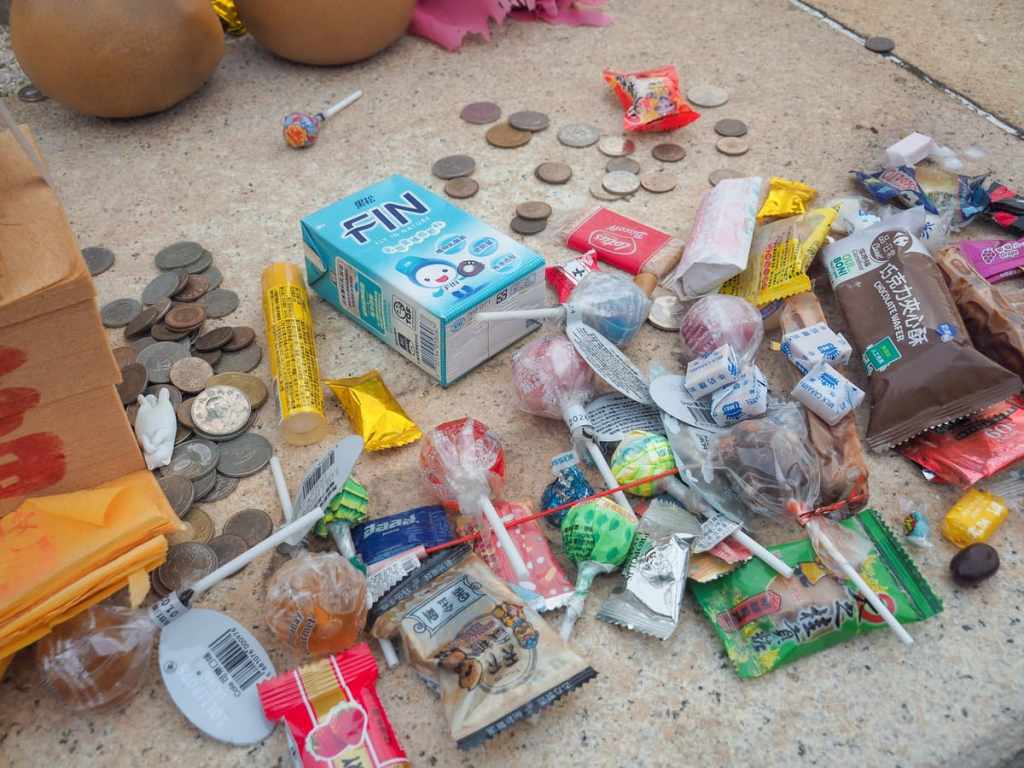
This one had a massive bounty of offerings on its altar. It also has visible bullet wounds and is very close to an abandoned tank.

85. Guanlubian Village – 官路邊
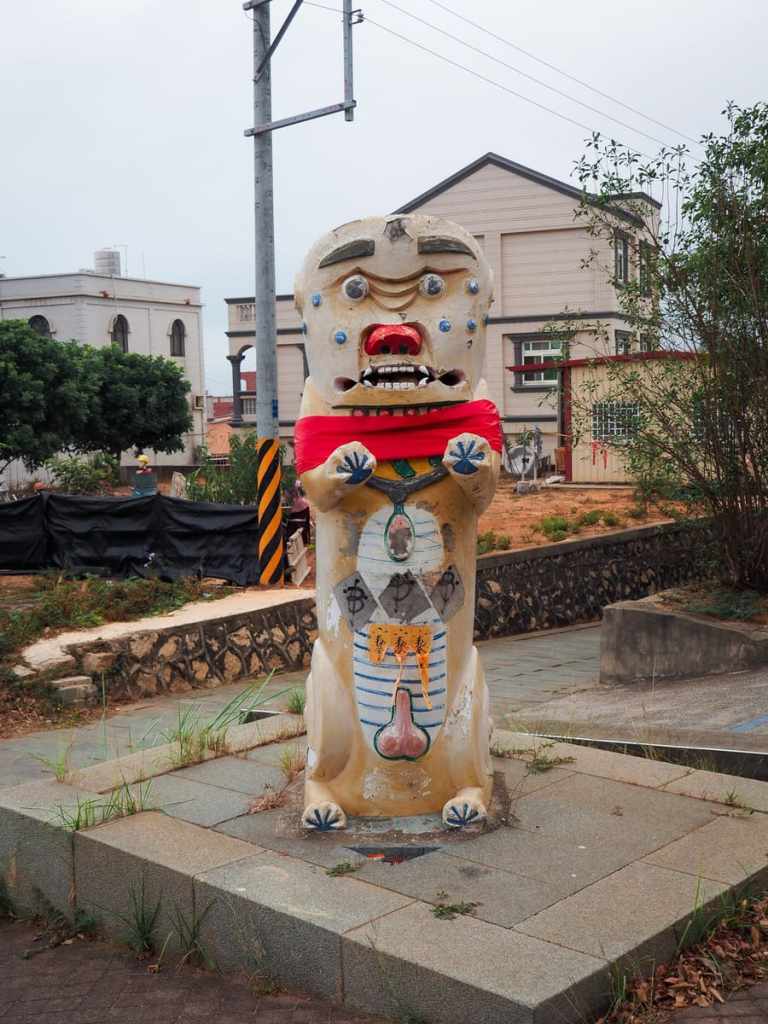
The Guanlubian Village Wind Lion God proved a little harder to locate, but after being waved in the right direction by a grandpa, we found it standing in a clearing fifty metres away from the village. It’s quite short, possesses an outsized gourd-shaped penis, and has an expression that is probably best described as impishly gleeful.

100. Houtou Village – 后頭
The Houtou Village Wind Lion Gods were two of only a handful of deities we encountered in on the small island of Lieyu. If we’d visited just a few months earlier, we’d have had to catch a ferry over, but these days, Little Kinmen is connected to the rest of Kinmen via a long and windy bridge. The taller and newer of the two statues was commissioned after the original was lost or destroyed in World War II. The smaller, older one may or may not be the one that was lost in the war, but it was definitely rediscovered after a period of being lost and enshrined next to its younger brother.
 Taiwan Trails and Tales