The vast majority of the trails in Yangmingshan National Park are open to visitors at any time of the day or night without any need for permits. However, in a handful of ecological protection zones, park authorities have implemented a permit system to cap the daily number of hikers. These areas are: Lujiaokeng, Mount Huangzui, Xiao Guanyin Shan, and Menghuan Pond.
For years, the application system has been a bit of a headache for any foreigner wishing to apply. Even for those with Chinese fluency, the system did not recognise foreign identification documents. People without Taiwanese citizenship only had three ways to enter the park’s quietest areas: illegally (never a good idea, don’t do it), with the assistance of a Taiwanese group leader, or via a long and convoluted back-and-forth conversation with park authorities. Mercifully, things have moved on, and as of 2022, the application process has been revamped and foreigners can apply as easily as locals. (Another change that happened around the same time is that the park began allowing solo hikers to make applications.)
So, without further ado, let’s look at how to apply for permits in Yangmingshan National Park.
Step 1: Find the right webpage
If you’ve never dealt with government-funded websites in Taiwan, you might think this is straightforward, but as of time of writing, but the closest Googling any combination of “Yangmingshan permit application” will get you is to a page on the website which informs you that “you must apply online” without actually linking to the page you need. So here it is. You can apply for your Yangmingshan permits at: https://applyweb.ymsnp.gov.tw/eng/members/. Side note, links on government websites change ALL THE TIME, so if you find this isn’t working, please give me a heads up so that I can update it.
Uh oh! It’s asking me to login.
Right. That takes us to step two…
Step 2: Register for an account

Scroll past Carefully read all of the terms and conditions and click on the “I agree” button.

You’ll be prompted to fill in the above form. It seems simple enough, but there are a couple of things worth pointing out. The form indicates that it wants your birthdate in the “year/month/day” order. This is incorrect. What it actually wants is “month/day/year”. Also, since neither “ID Card No.” nor “Passport No.” have an asterisk beside them, you might think that means you don’t need to enter one. This is also incorrect. You must enter one or the other (or both).
Step 3: Log in and navigate to the application page
This one is nice and easy. Once you’ve made an account, return to the login screen.

You’ll be prompted to enter the account details you just made, along with a four-digit captcha.

Once you’re in, you’ll land on a welcome page. Select the “Applying for visit to Ecological Protected Area” option.

That’ll take you to another page including important information about the areas, the specifics of the routes, and what regulations you are required to abide by.
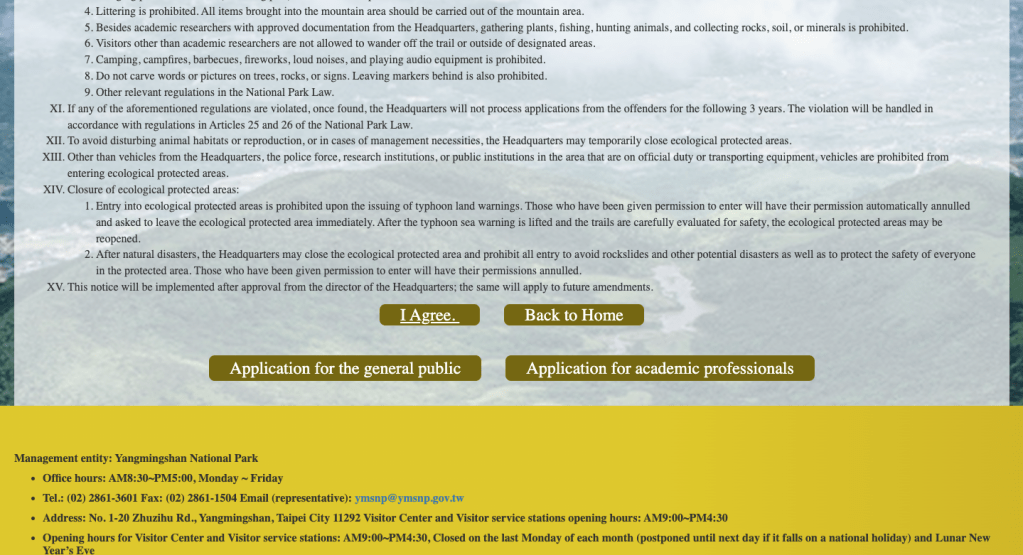
Scroll down to the bottom. Once you click “I agree”, a second option will pop up. Here you’ll need to select “Application for the general public”.
Step 4: Select a date and a route
Applications can be made three to thirty days in advance of your visit. Any dates which fall outside of those times are indicated show “You have selected a time not within operating hours”.

From the calendar, you need to click on the name of the walk you intend to do on the date that you plan to walk it. The numbers next to each walk tell you how many slots are still available on any given day. Routes that have no spaces available are displayed as being full.
Step 5: Fill out the form
This is the most involved part of the process, but even so, it’s pretty self-explanatory. The form does not seem to care whether you use Chinese or English, which helps if you’re applying for a mixed group.
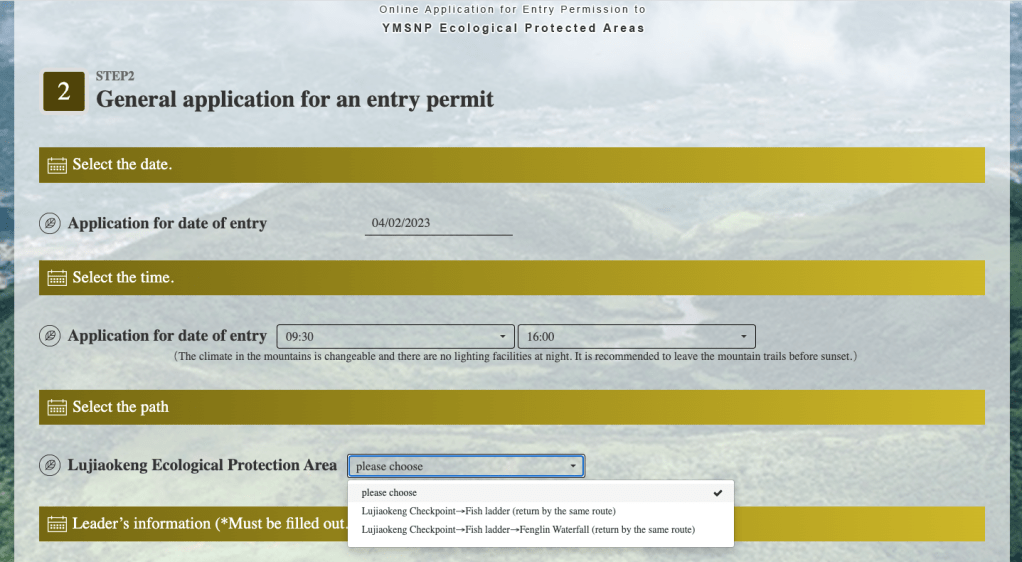
The date will already be filled out for you. You have a little flexibilty with what starting and finishing times you put in. And if you’re visiting one of the areas with multiple routes, you’ll need to make sure you choose the right one.

Since you’re making the application, the form automatically fills in a lot of your information. The only part you’ll need to add here is a team name. This can be as sensible or as silly as you like.

Add your emergency contact information. You need to fill in both phone number fields, but it’s ok to use the same number twice.

Read and check the box to confirm that you agree to follow the laws of the park and have prepared both yourself and any team members for the risks involved.
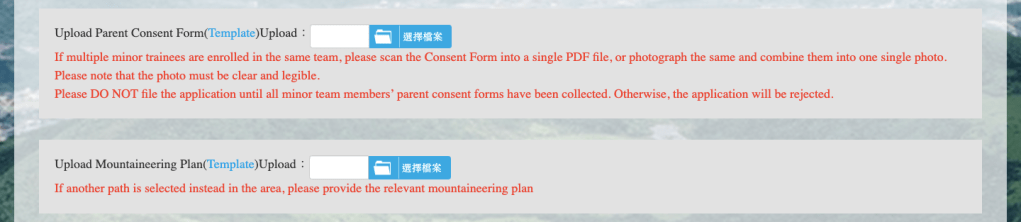
Most people can just scroll on down past this section. The top one is only relevant for people taking a group that includes minors (which means anyone under the age of 20). And the bottom one is for groups that are following a non-standard route (basically any routes through the protected areas that aren’t included as one of the options you could chose from).
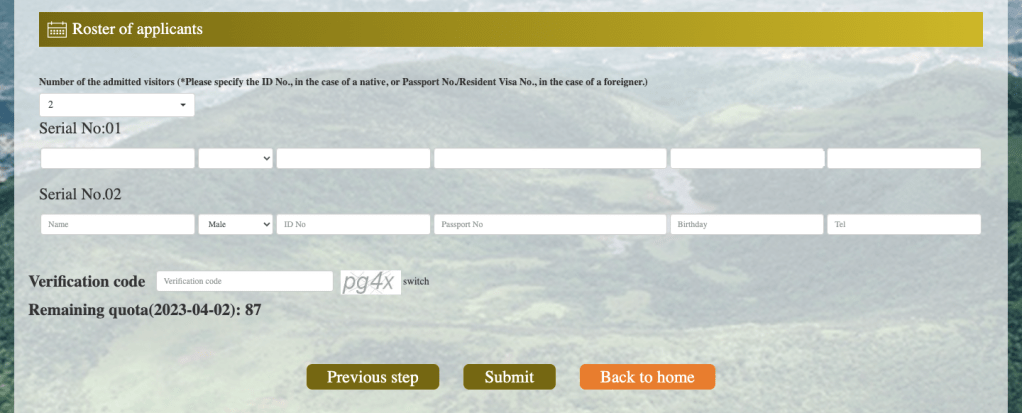
Finally, you’ll need to state how many people are in your group and supply their name, sex, ID number, passport number, birth year (not birthday as the form indicates), and telephone number. The team leader’s info will appear automatically, and since I was only applying for myself and my partner, I didn’t have too much work to do. However, if you’re coordinating a larger group, you’ll want to get all of this information together before you start the application process.
Once you’ve filled that in, enter another captcha, and hit “submit”.
Step 6: Congratulate yourself

This screen will pop up once you’ve submitted your application, and clicking “here” takes you back to the welcome page.
Step 7: Print out the permits
After about two working days, you will receive an email containing the permits. The email has two attached PDF files. Print copies of both. In some cases, you might need two copies.
Step 8: Present your permits
Depending on which route you take, when you arrive, you might have to show your permits to an actual person, put a copy of them in a mail box attached to a gate. At Lujiaokeng, we had to show them to the volunteer rangers, and they told us to keep the paper with us in case we ran into park rangers during our walk. I’d say that at Lujiaokeng, you’re unlikely to be asked to show your papers after passing through the control point since there isn’t another entrance, but I’ve heard of people being stopped by park rangers close to Huangzui Shan and Xiaoguanyin Shan.
 Taiwan Trails and Tales